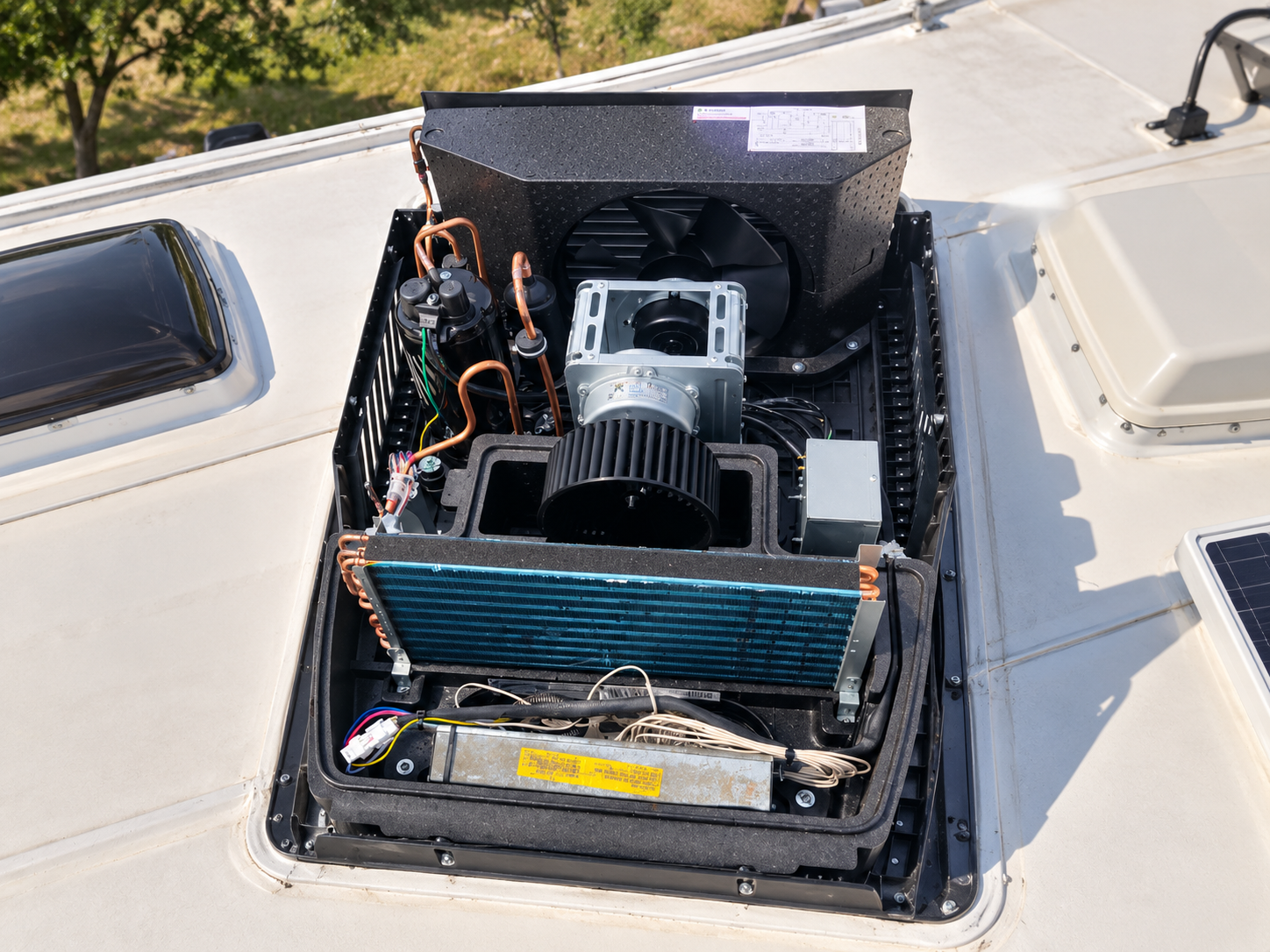
When North Texas temperatures stay near 100 degrees day after day, your RV air conditioner is putting in some serious overtime. So when your RV A/C isn’t cooling properly, starts blowing warmer air, or runs constantly without keeping your RV comfortable, one of the first questions we hear is:
“Does it just need Freon?”
With an RV rooftop air conditioner, you need to understand how they are built to answer that question.
RV Rooftop Air Conditioners Are Factory-Sealed Systems
RV rooftop air conditioners are built with factory-sealed refrigeration systems. Unlike the A/C system in your home or vehicle, they are not designed to have refrigerant routinely checked, topped off, or recharged.
The refrigerant circulates inside a closed system. It doesn’t get used up or wear out during normal operation.
So if an RV air conditioner is actually low on refrigerant, there is a leak somewhere in the sealed system.
An RV A/C That Isn’t Cooling Doesn’t Always Need to Be Replaced
Before assuming your RV air conditioner has lost refrigerant or needs to be replaced, it’s important to find out what’s actually causing the cooling problem.
Several other issues can affect RV A/C performance, including:
- Dirty air filters or coils restricting airflow
- A frozen evaporator coil
- Fan or blower problems
- Capacitor or other electrical failures
- Compressor problems or failure
- Thermostat or control issues
- Problems with ductwork or airflow
- Improper voltage or power supply problems
A proper RV A/C evaluation can help determine whether you’re dealing with a repairable component, an airflow or electrical problem, or a failure within the refrigeration system itself.
Sometimes the A/C is perfectly capable of cooling once the actual problem is corrected.
Is My RV A/C Broken or Is It Just the Texas Heat?
There is a difference between an RV air conditioner that is failing and one that’s working hard against extreme Texas heat.
An RV has far less insulation than a traditional home. Large windows, slide-outs, skylights, roof vents, and direct sun all contribute to heat entering the RV.
When we’re dealing with day after day of temperatures around 100 degrees in Fort Worth and North Texas, an RV A/C may run for long periods and still struggle to maintain the indoor temperature you’re accustomed to during milder weather.
That alone doesn’t necessarily mean something is wrong.
But if the air coming from the vents isn’t noticeably cooler, airflow has decreased, the unit repeatedly freezes up, you hear unusual noises, or the cooling performance has changed significantly from what it normally does, it’s worth having the system checked.
RV A/C Repair or Replacement: Which Makes More Sense?
The answer depends on what’s actually wrong.
If the problem is a capacitor, thermostat, airflow issue, dirty coil, electrical component, or another serviceable part, RV A/C repair may make perfect sense.
If the compressor has failed or the problem is within the factory-sealed refrigeration system, the economics can change quickly. Depending on the age and overall condition of the A/C, the cost of parts and labor can make replacing the rooftop unit the more practical choice.
Don’t Replace Parts Until You Know What’s Wrong
When an RV A/C isn’t cooling in this kind of heat, it’s tempting to start replacing capacitors, thermostats, or even the entire unit based on what someone online says the problem probably is.
That’s where DIY troubleshooting can get expensive.
Evaluate the system first. Find the actual problem. Then decide whether repairing or replacing it makes sense.
RV Mobile Medics Repair & Service can diagnose your RV air-conditioning problems at your location, eliminating the need to haul your RV to a shop. We provide mobile RV repair in Fort Worth and surrounding areas.
Leave a Reply